Display Interfaces Explained
High-Reliability Display Electronics for Professional, Industrial, and OEM Systems
Below is an engineering-focused overview of how these interfaces compare and where each is most appropriate.
Video Input Interfaces (Source → Controller)
HDMI (High-Definition Multimedia Interface)
HDMI is widely used for consumer and commercial sources, but is also common in professional systems where compatibility and ease of integration matter.
Key characteristics:
Designed for consumer and commercial video sources
Supports audio, HDCP encryption, and CEC
Bandwidth depends on version (HDMI 1.4 → 4K30; HDMI 2.x → 4K60 and above)
TMDS signaling, moderate cable lengths
When HDMI is used:
Applications requiring broad compatibility with PCs, media players, and embedded systems
Signage, kiosks, broadcast monitoring, general-purpose video display
Integration notes:
Cable quality and length strongly affect signal integrity
HDCP and EDID must be considered when integrating with protected content sources
DisplayPort (DP)
DisplayPort provides higher bandwidth and more robust signaling than HDMI, making it better suited for 4K, 8K, and multi-lane professional applications.
Key characteristics:
Packet-based protocol designed for high performance
Supports multiple lanes for increased bandwidth
Allows daisy-chaining through Multi-Stream Transport (MST)
Excellent signal integrity for higher resolutions
When DisplayPort is used:
High-resolution 4K/8K systems
Professional graphics workstations
Control rooms, medical imaging, simulation, defense
Integration notes:
More tolerant of long cable runs than HDMI
Panel-side integration still requires conversion to eDP, LVDS, or V-by-One via a controller
Panel Interface Technologies (Controller → LCD Panel)
eDP (Embedded DisplayPort)
eDP is a panel interface, not a video input. It is optimized for internal display connections and increasingly common in newer industrial panels.
Key characteristics:
High bandwidth with reduced wiring relative to LVDS
Lower power consumption
Supports features such as Panel Self Refresh
Strong roadmap longevity
When eDP is used:
Newer industrial and commercial LCD panels
Applications needing compact signal routing and lower EMI
Integration notes:
Selection of lane count and link rate is critical
Requires careful attention to cable length and integrity
Controller must match the panel’s exact timing and link configuration
LVDS (Low-Voltage Differential Signaling)
LVDS has been the dominant panel interface for industrial displays for many years.
Key characteristics:
Mature, well-understood technology
Robust in noisy environments
Supports many existing industrial and medical panels
Limited bandwidth compared to eDP and V-by-One
When LVDS is used:
Legacy or long-lifecycle industrial and medical panels
Applications where EMI resilience is critical
Systems requiring predictable behavior over many years
Integration notes:
Cable length and impedance must be tightly controlled
Timing configuration is essential for flicker-free operation
V-by-One (Vx1)
V-by-One is a high-speed serial interface designed to deliver large bandwidth over a small number of differential pairs.
Key characteristics:
Very high data rates per lane
Highly scalable to 4K, 8K, and above
Reduced cable bulk compared to LVDS
Excellent noise immunity
When V-by-One is used:
Large-format displays
High-resolution industrial signage
Broadcast, control, and visualization systems
Integration notes:
Requires strict clocking and timing management
Cable design and EMC control have meaningful impact
Ideal for pairing with Digital View’s high-end 4K/8K controller families
How Digital View Controller Boards Support These Interfaces
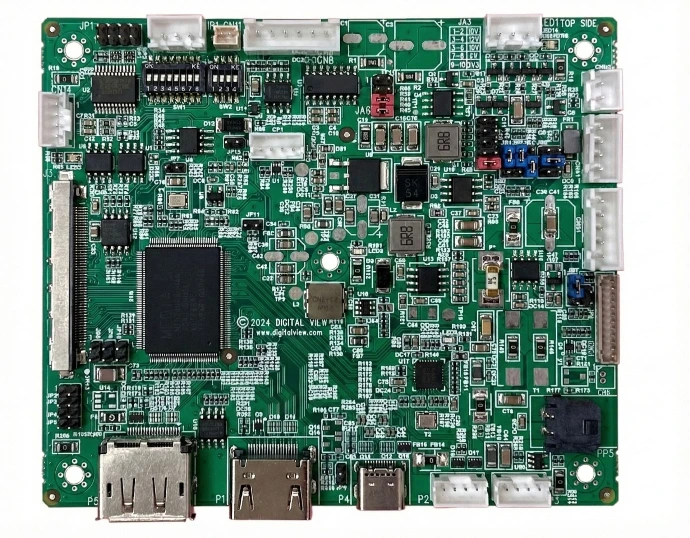
Digital View controllers sit at the center of the display architecture, managing the complete signal chain:
Video input → signal processing → panel interface → backlight control
Each controller family supports a specific combination of input formats, processing features, and panel interface technologies.
- Inputs: HDMI, DisplayPort, SDI, and selected analog legacy formats
- Panel outputs: LVDS, eDP, or V-by-One, depending on the model
- Processing: Scaling, gamma adjustment, dithering, color management, and low-latency paths
- Configuration: Firmware profiles for panel-specific timing, EDID management, and operating parameters
This clear separation between video inputs and panel drive interfaces provides OEMs with:
Flexibility to upgrade or change video sources without redesigning the display hardware
A straightforward path to adopt new LCD panels, even when interface technologies evolve
Long-term product stability, supporting extended lifecycles and predictable field performance
Choosing the Right Interfaces for Your Display Application
In display system design, interface choices happen at two different layers:
Video input interface (source → controller) — the designer chooses this.
Panel interface (controller → LCD panel) — the panel dictates this.
The system designer does not choose LVDS, eDP, or V-by-One independently; that decision is made when selecting the LCD panel.
Digital View controllers then ensure compatibility between the chosen panel and the chosen input source.
1. Selecting the Video Input Interface (Source → Controller)
Use HDMI when:
Source compatibility is the priority
The system uses PCs, media players, SBCs, or commercial devices
The application involves signage, kiosks, or general-purpose video streams
Use DisplayPort when:
You require 4K/8K performance or high bandwidth
You need robust transmission or longer cable runs
The application is mission-critical: medical, defense, control rooms, simulation
Use SDI when:
You need long-distance cable runs
You operate in broadcast, surveillance, or rugged environments
(Input interfaces end here — the user does not choose LVDS/eDP/V-by-One at this stage.)
2. Panel Interface (Controller → LCD Panel)
Generally determined by the choice of panel. The following shows some common characteristics - in any case, Digital View has models for each of these.
LVDS:
The panel is a legacy or long-lifecycle industrial/medical display
You need predictable, stable performance in EMI-challenging environments
eDP:
Working with newer, power-efficient industrial or commercial panels
You want fewer conductors and improved EMI performance
V-by-One:
Driving large-format or high-resolution displays (4K, 8K)
High bandwidth and reduced cable bulk are required
Integration Considerations
Cable impedance, shielding, and length dramatically affect signal integrity
EMI/EMC requirements vary by industry—particularly medical, defense, marine, and industrial automation
Timing and clock configuration must match panel specifications exactly
Backlight control, power sequencing, and firmware all contribute to long-term system reliability
Our engineering team supports OEMs with panel validation, configuration guidance, and technical documentation.
Frequently Asked Questions (FAQ)
They operate at different layers of the system and are not interchangeable.
Designers choose the panel, and that choice determines whether LVDS, eDP, or V-by-One is required. The controller must match the panel’s interface.
Choose based on the video source and performance needs:
HDMI for broad compatibility
DisplayPort for high bandwidth (4K/8K) and professional applications
SDI for long-distance or ruggedized environments
The controller will adapt the input format to the panel interface.
- Long lifecycle availability
- EMI robustness
- Predictable, stable behavior
Even as eDP and V-by-One expand, LVDS is maintained for backward compatibility and product longevity.
They translate the incoming video signal (HDMI/DP/SDI) into the panel’s required format (LVDS/eDP/V-by-One), while handling timing, scaling, gamma, color management, EDID, and backlight control. This enables panel changes or source upgrades without redesigning the whole system.
Next Steps
To select the right controller for your display system:
Speak with our engineering team
Request a controller selection review
Provide your panel specifications for compatibility confirmation
Digital View supports OEMs, integrators, and engineering teams throughout the entire product lifecycle—from concept through production.